Launch event and more

Ramzan mubarak to all who observe. It’s Day 6 in New Jersey, and every evening, as I foam milk for coffee, my one regurgitative thought is that I’d like to be a smoker simply to experience what the first drag must feel like after a whole day of fasting.
A Splintering is on the shortlist for the Stanfords Prize in the UK. In the US, it has received dream coverage in the early trade reviews—Kirkus and Booklist both gave it starred reviews. It releases here on April 14, with the launch event on April 13 at McNally Jackson, hosted by Acacia Magazine. I’m over the moon to have Benjamin Moser, Pulitzer-winning author of the one of the best biographies I’ve ever read (Sontag), and beloved friend, as the moderator for the event. Tickets here. Books can be pre-ordered here or here. I’ll also be visiting Washington D.C., Austin, and Toronto, so more dates to follow.
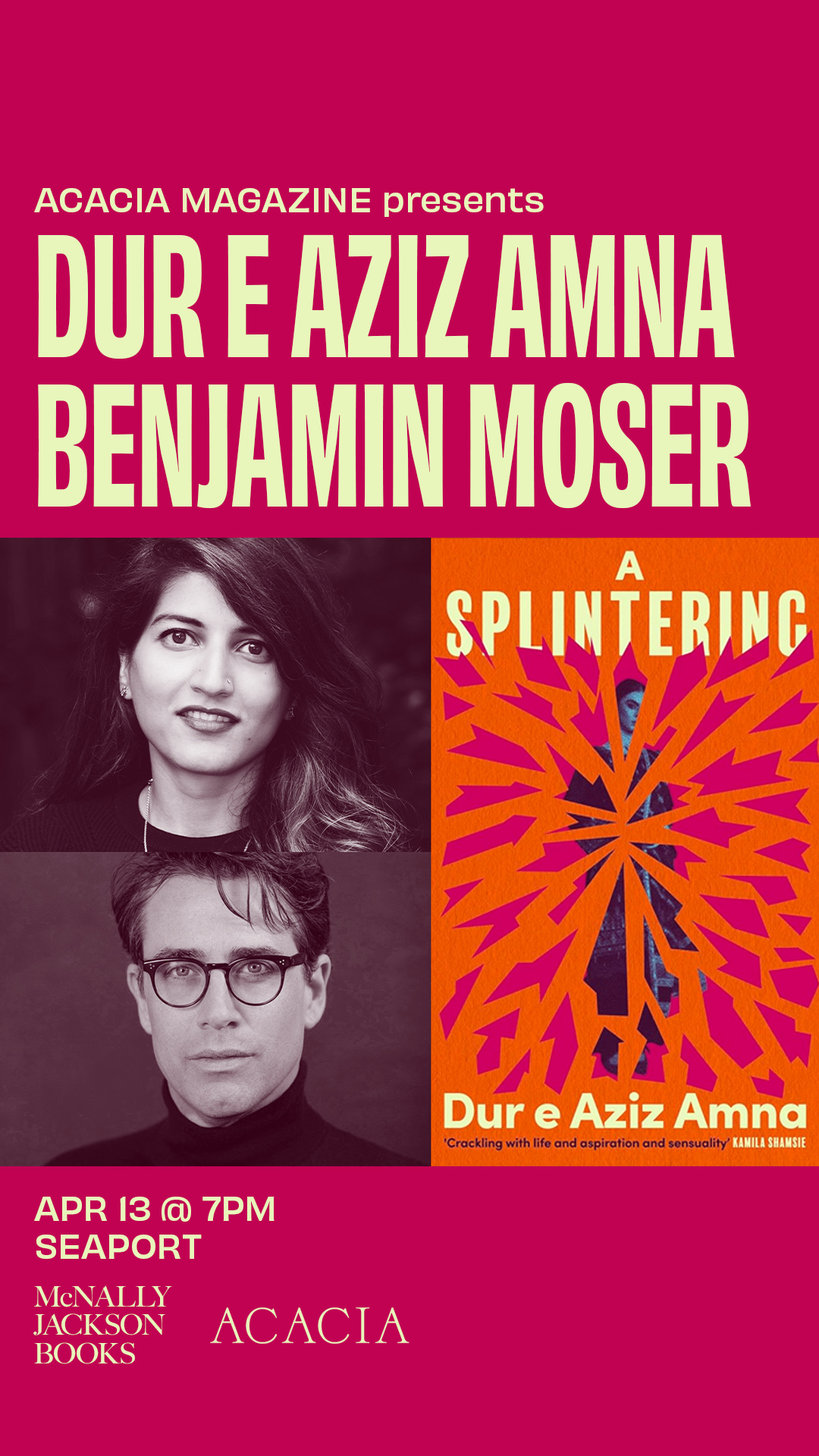
As for the book itself. I’ve written about the origin story for the novel on the newsletter before, but for new followers, here’s an excerpt below.
—
“In 2021, and more recently in 2024, early spring, I conducted writing workshops with students at Quaid-e-Azam University in Islamabad. My ties with the university run deep. My father attended in the ‘80s, during Zia-ul-Haq’s regime, and regaled us with stories throughout our childhood, of organizing with the progressive students’ party, attending classes on American history, and spending afternoons huddled over chai at the makeshift tea canteens. The university has always struck me as an architectural marvel—strict, angular modernist architecture, the one South Asia embraced so devotedly in the ‘50s and ‘60s with the skin-shedding fervor of the post-colony, surrounded by wild growth in the form of shrubs, ancient trees, and embraced, finally, by the Margalla Hills.
In 2024, the workshop was focused on land and place. I asked the students to write a letter to a stranger, describing their hometown. Because QAU is a federal university with students coming in from around the country, almost everyone was from a different town or city. One of my favorite letters was written by a student from Zhob, a city at the northern edge of Pakistan’s most impoverished and neglected province, Balochistan. He wrote, in beautiful, polished Urdu, a letter inviting the stranger to his city. He instructed the stranger to take the bus in, get off at the station, then go to a certain stall for the sweetest chai of her life. He described the bite of early mornings in the city, and the warmth of nights spent in cozy rooms surrounded by loved ones. Later, the student mentioned that he had learned the love of vatan, or homeland, from a Soviet poet. He was speaking of Rasul Hamzatov, an Avar poet from Dagestan, a republic in the Eastern hinterlands of Russia. Hamzatov’s book, My Dagestan, is an ode to his homeland, full of nostalgic yearning for the simplicity and hospitality of the life he abandoned for Moscow. The Urdu translation that the student was mentioning is a brilliant piece of work. It is one of my father’s favorite books.
Later still, the same student admitted to complicated feelings about Zhob—having left it for the capital city, there were certain provincialities that he detected when he returned home for visits, totems of backwardness that had only made themselves visible to him after he left. He didn’t know whether he had changed, or the place had, in the few years that he had been away. He was intelligent enough to have a guess.
**
I’m thinking of the student today, his beautiful letter, his move from periphery to center. The tale of the provincial migrant, her travel set against a rapidly urbanizing region, is perhaps the most significant story of modern South Asia. I’ve been thinking about it for a few years now. In fact, I wrote a whole book about it. My second novel, A Splintering, is the story of Tara, a young woman who leaves rural poverty through marriage to a city accountant, only to realize that her ambitions far outstrip the fruits of middle-class respectability. She wants more, more, more. And she will do anything to get it.
Tara’s character came to me while I was swimming in Ferrante’s Neapolitan novels—”swimming” feels right, because while I was reading them, the novels became my atmosphere, the air I was breathing—and once she came, she would not let me go. I was enthralled by this woman, who would stop at nothing to get what she wanted. She is a biting, unruly character in a lot of ways, but one of the things that fascinated me the most was the violent hatred she harbored for her hometown. Perhaps I wrote the book as a rebellion against books like Hamzatov’s, which I admired so much but which struck me as unequivocally masculine in its unchecked, unqualified nostalgia for the past. I have only ever met nostalgic men. No woman I know wants to unconditionally turn back time. Tara remembers her hometown for its enclosures, its stifling walls plastered with dung cakes, its narrow provincialities. Unlike my student, she saw no redemption in the place. I advise for balance in real life, but in this novel, I was working determinedly against the well-rounded character, the believable, realistic character who feels like a bit of everything. I didn’t want a character that was good and bad, meek and loud, funny and sad, a person with pH 7. I wanted a woman who was acid rain.
There’s more to the novel than the move to the city; the real adventure begins after she arrives. There’s marriage, and motherhood, and a shocking, life-changing decision. There’s the background of fin de siècle Pakistan—hobbling adventures in democracy, regime change, the War on Terror as it permeated the heartland, the liberalization of media, and more.”
—
If that interests you, do pre-order the book (here or here)
In January, I was in Lahore. I got northern / central Punjab at its bone-chilling coldest—my husband, who saw several blizzards and snow storms as a kid growing up in Jersey, insists Islamabad is the coldest place in the world, and I’m inclined to agree. While in Lahore, I got a chance I’ve dreamed of for years—to interview Mohammed Hanif, on the occasion of his latest book coming out. I also reviewed the book, if you’d like to read.
After I accurately predicted a Booker win for my favourite novel of last year, I got mouth from multiple people who thought Flesh wasn’t all that great. They’re so, so wrong, but also, a little more generously, one’s reaction to a book is highly contextual. I loved Flesh because I feel I have spent a few years reading highly introspective and slow works, almost always by women, and so Flesh filled a particular emotionally handicapped man shaped hole in me.
Since Flesh, I’m finding myself reading only men. I will not be psychoanalyzing this. Some of the things that have stood out to me:
I’m towards the end of Fintan O’Toole’s We Don’t Know Ourselves, a history of modern Ireland, and specifically its transformation from a conservative, deeply Catholic society to one that’s…less so. It's not always productive to see everything as a slanted image of home, but, see above, your context is your context. The postcolonial parallels with a place like Pakistan are jarring at times. Ireland in the vacuum of independence, Ireland creating a national identity that is deeply fused with religion, Ireland in the agonies of the language wars. Catholic Europe went hard.
I re-read Edward Albee’s Who’s Afraid of Virginia Woolf, perhaps my favorite play ever, and J. L. Carr’s A Month in the Country, about a WW1 veteran’s brief summer spent restoring a medieval church in rural England. Absolutely stunning books, both of them. Albee’s play was also made into a fantastic movie.
I just started Naipaul’s A Bend in the River, and I’m absolutely enthralled by the self-hatred and shame of the main character. I read Naipaul’s breakthrough book, A House for Mr. Biswas, many years ago, and recently got back into him after reading this lovely piece on him by Aatish Taseer. I really recommend giving it a read; it’s basically just Naipaul pontificating as he moves through a museum, and it’s delicious.
The other day someone mentioned having a favorite qawwali, which is a question I’ve never even asked myself. It’s like having a favorite book; how? This is the one I’ve been listening to on repeat this Ramzan.
All the best,
Dur e Aziz